What it's about
This AI cycle began with two promises. First: more productivity. Second: less work. Four years ago, a Google engineering director predicted a four-day week by 2025. In early 2026, OpenAI called on other companies to test the four-day week, on full pay.
The first promise is wobbling. The second is off the table.
What happened
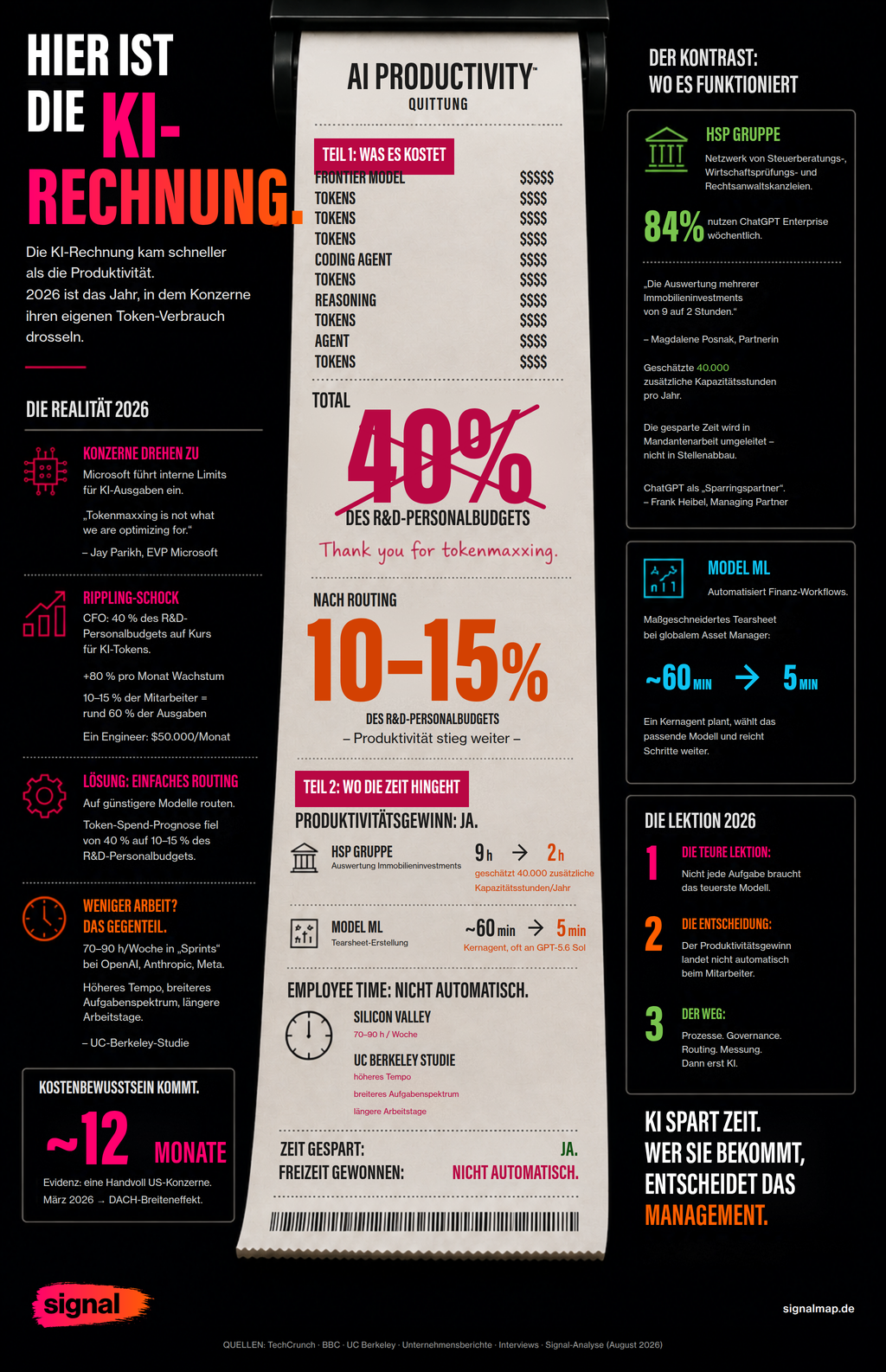
The companies are turning down their own consumption. Microsoft has introduced internal limits on AI spending. EVP Jay Parikh to staff: "Tokenmaxxing is not what we are optimizing for." GPT-5.6 is becoming the internal default model, because it's cheaper. Microsoft isn't short of cash: its latest results beat Wall Street expectations. An anonymous Microsoft employee puts it in a nutshell: if the operator of the AI infrastructure throttles its own products, what does that mean for the customers?
The numbers behind it are real. At Rippling, CFO Adam Swiecicki presented a figure in March that left the leadership team stunned, according to Chief Product Officer Matt MacInnis speaking to TechCrunch: the company was on course to spend 40 per cent of its R&D personnel budget on AI tokens. Growth: 80 per cent month on month. 10 to 15 per cent of employees drove around 60 per cent of the spending, and a single engineer burned through $50,000 a month. Rippling then built its own tool that measures AI spending per employee and ties it to actual productivity. Result: the forecast for token spend fell from 40 to 10 to 15 per cent of the R&D personnel budget. According to Rippling, productivity kept rising, because the limit made the engineers smarter and no less capable. What did it was simple routing to cheaper models.
Less work? Quite the opposite. Employees at OpenAI, Anthropic and Meta tell the BBC of 70 to 90 hours a week in "sprints". At Meta, people were moved onto AI teams by "drafting", with no choice. A UC Berkeley study over eight months found that employees worked at a faster pace, took on a broader range of tasks and stretched work into more hours of the day. Neil Thompson (MIT) says people assume 20 per cent less work means a four-day week, but that new work gets created.
The people at the top say it openly. Sam Altman doesn't expect a shorter week, and says employees are secretly glad to work harder. Meta CTO Andrew Bosworth curtly dismissed a question about more holiday in a Q&A and later half-apologised. The context: a workforce that has lived through around 8,000 lay-offs at Meta this year. We don't joke about those lay-offs or the pressure on the employees.
The contrast: where it works
Two customer case studies show the other side, with numbers and names.
At HSP GRUPPE, a network of independent tax advisory, audit and law firms, 84 per cent of staff use ChatGPT Enterprise every week. According to partner Magdalene Posnak, analysing several real estate investments has gone from nine hours to two. An estimated 40,000 additional hours of capacity a year. The crucial point: the firms are already working at full capacity, with backlogs. The time saved goes into client work rather than job cuts. Managing Partner Frank Heibel describes ChatGPT as a sparring partner. Final professional responsibility stays with the qualified professional.
At Model ML, which automates financial workflows, a custom tearsheet for a global asset manager now takes five minutes instead of around an hour. A core agent plans, picks the right model and hands steps on, often to GPT-5.6 Sol.
The difference between HSP and the Silicon Valley workforces lies in what happens to the time saved.
What this means for Germany
The German Mittelstand has a rare advantage in this debate: its turn comes later, so it can skip the mistakes of the early phase. The expensive lesson from Rippling and Microsoft is already documented: everyone reaching for the most expensive frontier model for every task. If you start in 2026, you know what you need: several models at different prices, a gateway that routes by task, and a measurement that ties spending to productivity. According to Rippling CEO Parker Conrad, GLM 5.2 performs almost as well as frontier models, at 85 per cent lower cost. In the same benchmarks Rippling ran for its own internal applications, Grok came out ahead overall.
And the harder question: the productivity gain is real, but it doesn't reach the employee automatically. Where it does, as at HSP, someone decided it should. It isn't a side effect of the technology. HSP shows the pattern that works. The firm built processes and governance first, and introduced AI afterwards.
When will cost awareness arrive broadly in the DACH market? Reckon on about twelve months, based on the gap between the first tokenmaxxing retreats in the US (March 2026) and the typical adoption curve. Evidence from a handful of US companies, but the pattern is consistent.