What it's about
The headlines belong to the big numbers. Visa is cutting 2,600 jobs, Meta cut 8,000 in May. Both cite AI as a factor. That reads like mass job losses through automation. The data says something else, and that something else matters more for workforce planning in German companies than any corporate announcement.
What the evidence shows
Hiring happens elsewhere. According to the US Bureau of Labor Statistics, almost 93 per cent of all hires by private employers in May came from businesses with fewer than 1,000 employees. According to a Business Insider analysis, firms with 5,000 or more employees accounted for only one to two per cent of hires over the past two decades. If you equate mass lay-offs at large corporations with job losses across the whole economy, you're measuring the wrong thing.
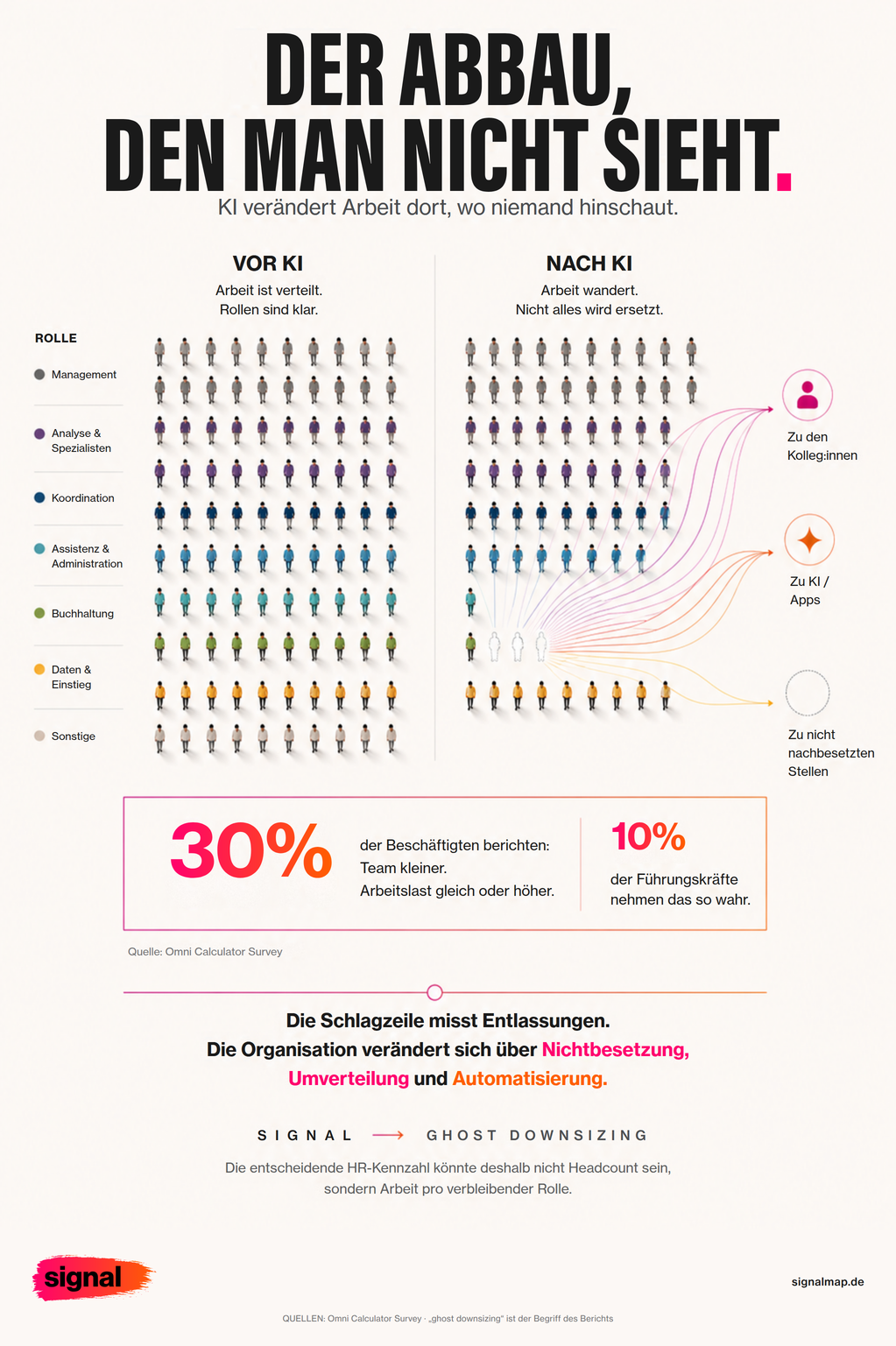
The real cuts are invisible. The Polish technology and research company Omni Calculator found in a survey that 30 per cent of employees report their team has shrunk while the workload stayed the same or rose. Among managers, only 10 per cent say so. Vacancies are no longer filled, and tasks are spread across the remaining staff and apps. The report calls it "ghost downsizing". Only 23 per cent of the companies surveyed have a formal AI readiness programme with its own budget; 40 per cent describe their AI roll-out as ad hoc.
Some are hiring more because of AI. On 29 July 2026, ZipRecruiter surveyed more than 1,000 US recruiters and HR decision-makers. 35 per cent expect AI to increase their total workforce. Where AI has already affected headcount, 24 per cent are hiring more as a result, 16 per cent fewer. JPMorgan chief Jamie Dimon reports areas with 30 to 40 per cent fewer positions, where most of those affected received other offers. Even OpenAI chief Sam Altman is backing away from his mass job-loss forecasts. The risk to entry-level jobs is well founded: almost 40 per cent of employers have started handing entry-level tasks such as data entry over to AI.
The distribution isn't neutral. In the US, 2 million women hold secretarial and assistant jobs with an automation risk score of 96. HR Executive gives that score on 29 July 2026, with no data source and no scale. Accounting: over a million jobs, score 98, also according to HR Executive, more than 84 per cent held by women. At the same time, according to Harvard research, women experiment with AI less often, partly out of concern that using it is unethical. The second effect comes later: the economist Alex Imas argues that as the cost of knowledge falls, demand moves to relational work, to care, support and advice. These are female-dominated fields. The sociologist Paula England showed, however, that when men enter a field, pay and status rise. If the relational sector becomes a growth industry, new pay baselines could emerge in which the women who built these professions have no share.
The legal ground is shifting
Two fronts. First, the Meta lawsuit: 26 laid-off employees accuse the company of letting AI influence the selection for the lay-offs. In a court filing, HR director Linh Doan stresses that human managers made the decisions and that AI was not involved. What remains open is whether employees' AI use fed into performance reviews, which in turn were a criterion for the lay-offs. Several plaintiffs say their AI usage scores fell while they were on leave.
Second, Mobley v. Workday: a US court ruled that Workday's AI-assisted applicant tools can be the subject of discrimination claims, nationwide, under Californian law. On 22 June 2026 the court held that a party based in California can open the way to a claim under the anti-discrimination law FEHA even for applicants with no connection of their own to California. Workday had to hand over a list of all customers using these tools. For HR departments, that means: document human oversight of AI tools, secure bias testing and audit rights in the contract, and divide responsibility clearly with the vendor.
The factor no dashboard measures
The DHR Global Workforce Trends Report 2026 (1,500 knowledge workers in North America, Europe, Asia) shows a slump: the share of very or extremely engaged employees fell from 88 per cent in 2025 to 64 per cent in 2026. 83 per cent report burnout. Entry-level staff are hit hardest, the C-suite least. When an AI does the visible part of a role in seconds, "Am I losing my job?" gives way to another question: "Who am I here now?" That appears in no performance review. It shows up as a slow withdrawal by people who are still fully present.
And monitoring makes it worse. ExpressVPN surveyed 1,500 US employers and 1,500 employees: 61 per cent of companies measure productivity with AI-assisted analytics. According to WebsitePlanet, employees under monitoring are 1.5 times more likely to report poor mental health. A study cited in Harvard Business Review found that monitored employees are more likely to break rules. According to Software Finder, 66 per cent stay online after the actual work is done, just to look busy.
What this means for the DACH market
In the US, the labour market regulates this through collective agreements: NewsGuild-CWA has 85 to 90 contracts with explicit AI clauses, and SAG-AFTRA prohibits AI replicas of actors without consent. Around 90 per cent of US employees have no union representation. In Germany, the starting point is different. Co-determination and the works council are built in. The German Mittelstand has a structural advantage here that is missing from the US reports: the mechanism American tech workers are only now painstakingly organising for themselves is the starting point in Germany.
What can be derived concretely from the evidence: if you automate, know beforehand which roles are exposed and who holds them. Upskilling plans belong before the restructuring. And the legal lesson from Mobley v. Workday applies to anyone buying AI-assisted HR tools. Whether and when these waves of litigation reach European courts is open. So far, the data comes from one market.
The quietest signal is often the most expensive. A dashboard that measures attendance doesn't see the absence that counts.