What happened
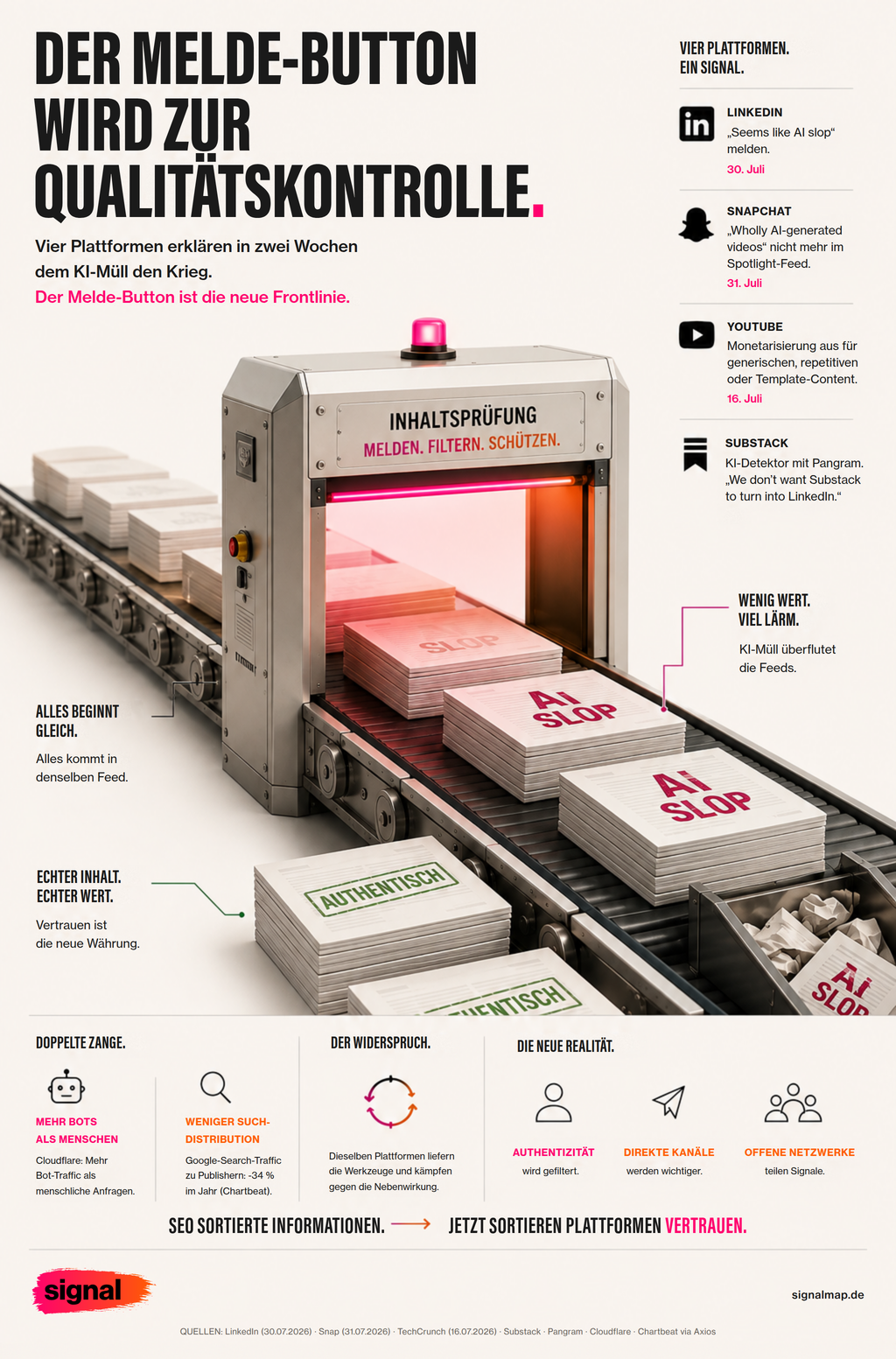
On 30 July, LinkedIn introduced a button that lets users flag posts as "Seems like AI slop". Chief Product Officer Hari Srinivasan wrote: "AI slop is a top priority for all of us." According to the AI detector Pangram, 41 per cent of long-form posts on LinkedIn were classified as fully AI-generated, and 62 per cent of all posts Pangram flagged as AI-generated were on LinkedIn, which accounted for only a third of the content scanned. LinkedIn says it blocks hundreds of thousands of automated comment attempts every day. At the same time, the platform is withdrawing its own "Enhance your post" feature and replacing it with a pure proofreading function that no longer rewrites the text.
On 31 July, Snap announced it would no longer recommend "wholly AI-generated videos" in its Spotlight feed. On 16 July, YouTube clarified its monetisation rules: generic, repetitive or template-based content is excluded from the Partner Program. Head of Trust and Safety Matt Halprin: "The same technology really enables great stuff. But it also enables stuff that's kind of content farming." Substack launched an AI detector in partnership with Pangram. CEO Chris Best named LinkedIn outright: "We don't want Substack to turn into LinkedIn." His line on the matter: "Platforms that reward fakeness will create a race to the bottom."
Why these are connected
Cloudflare reports that there is now more bot traffic on the web than human requests. That point was reached sooner than predicted. Meanwhile, search distribution is falling away: Chartbeat data reported by Axios show that Google Search traffic to publishers fell by 34 per cent over the past year. Small publishers lost 60 per cent of their search referrals over two years, large ones 22 per cent. Google increasingly answers questions itself with AI instead of sending readers on.
It's a squeeze from both sides. Feeds are filling up with machine-made content while the channel that used to distribute real content dries up. Pangram surveyed 2,557 US adults, 9 to 13 April 2026: 71 per cent of online users see AI-generated posts or articles at least several times a week, and 69 per cent trust AI content less than human content. That is exactly the business risk the platforms have now discovered at the same time.
The contradiction nobody is resolving
The same platforms fighting the slop supply the tools for it. LinkedIn is still promoting an AI writing assistant for profiles which, according to its own help page, draws on insights from millions of analysed profiles. Snap keeps its own AI editing tools and filters only "wholly" generated videos. Critics see the report button as unpaid user labour that becomes training data for LinkedIn's own AI classifiers, and warn of an avalanche of false positives. Notable all the same.
For the German market, one question matters: how will reach come about when Google no longer sends traffic on and feeds filter for authenticity? Axios is already betting on GEO, the successor to SEO tailored to LLMs, plus direct channels such as newsletters and events. Bluesky CEO Toni Schneider is building an open alternative in which moderation works as a shareable data signal: if one team marks something as AI slop, others in the network can adopt that signal. Bluesky says it sends two million clicks a day to publishers.
In context
The announcements are real, the numbers come from self-selected samples, and the intentions diverge. What's happening here admits a problem. It doesn't solve one yet. What's new is four platforms acting in the same window. Anyone in Germany still planning to build reach through the open feed and Google Search is planning for a world that is closing as we speak. The report button is going to be kept busy.