What it's about
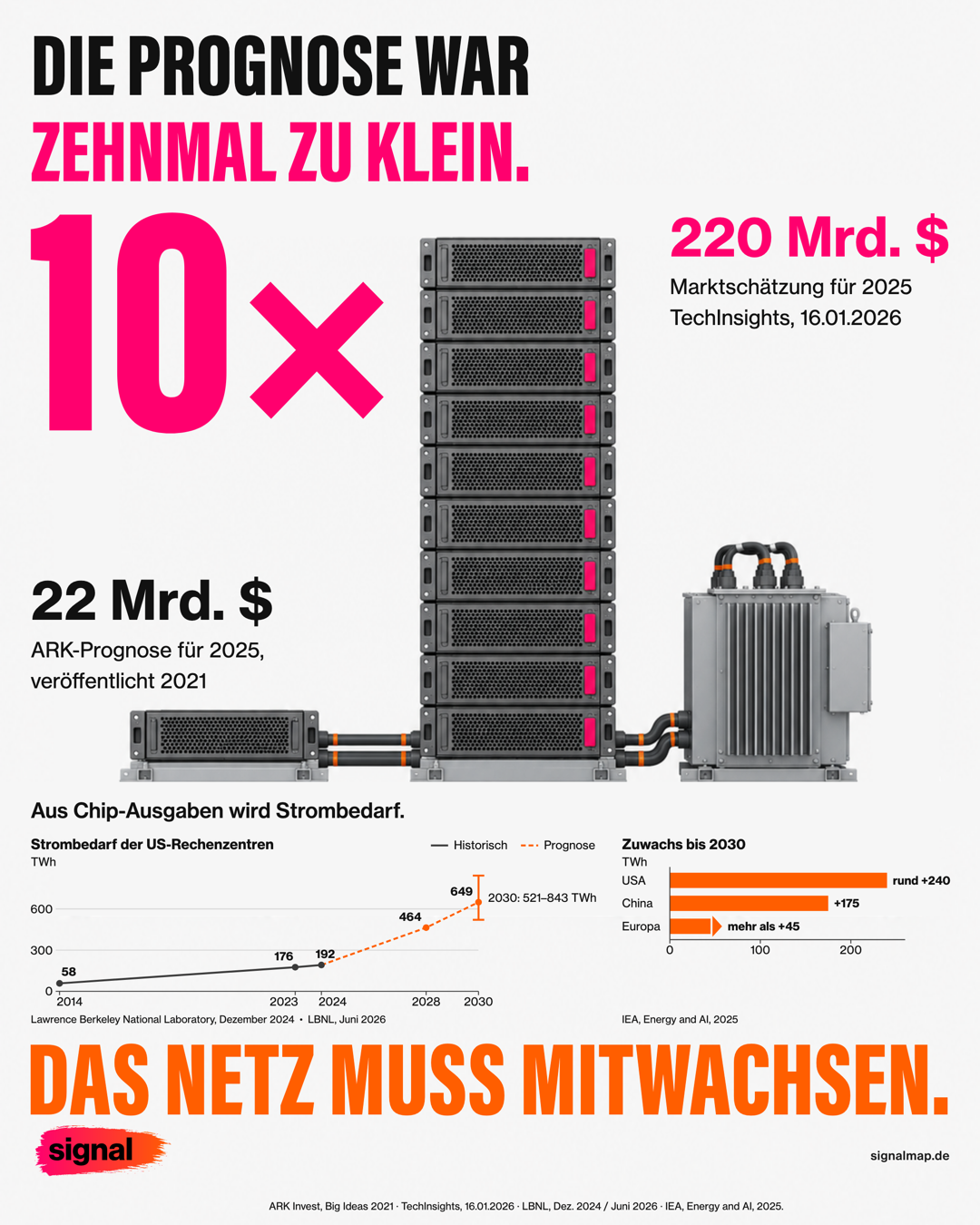
In January 2021, ARK Invest wrote that data-centre spending on AI processors would more than quadruple by 2025, from $5 billion to $22 billion a year (ARK Invest, Big Ideas 2021). At the time, that counted as bold.
TechInsights puts 2025 at $220 billion (TechInsights, 16 January 2026). NVIDIA alone took $193.7 billion in its data centre business in the fiscal year to January 2026 (NVIDIA, 25 February 2026). The direction was right. The size was out by a factor of ten.
Spotting a phenomenon and missing its size by an order of magnitude isn't foresight. So in our Reckoning, ARK sits under "far exceeded", not among the hits.
Why it matters
Every one of those chips needs power, around the clock. US data centres used 58 TWh in 2014. By 2023 it was 176 TWh, 4.4 per cent of US electricity (Lawrence Berkeley National Laboratory, December 2024). In 2024 they reached 192 TWh, 4.7 per cent. The lab expects 22 per cent more for 2025 and 464 TWh for 2028. For 2030 it expects 649 TWh, or 11.8 per cent of US consumption, within a range of 521 to 843 TWh (LBNL, June 2026).
Worldwide, demand in 2024 was 415 TWh, around 1.5 per cent of global electricity. By 2030 it doubles to about 945 TWh (International Energy Agency, Energy and AI, 2025). In 2025 alone it rose by 17 per cent (IEA, 16 April 2026).
The US adds around 240 TWh by 2030, China 175, Europe a little over 45. In 2024 the US accounted for 45 per cent of consumption, China for 25 and Europe for 15 (IEA).
The bottleneck is the grid
The Future Today Strategy Group puts it plainly in its Convergence Outlook 2026: "Electricity availability, not chips or capital, is increasingly the limiting factor, as single AI data centers draw hundreds of megawatts and collide with grid capacity, baseload generation, and transmission timelines" (FTSG, Convergence Outlook 2026, p. 70).
Ireland shows what that looks like. Data centres there used 23 per cent of metered electricity in 2025, up from 5 per cent in 2015. All urban households put together came to 18 per cent (Central Statistics Office, 7 July 2026).
What follows from this
Data centres in the EU used 68 TWh in 2024. By 2030 that's set to reach 114 TWh, 3.2 per cent of EU electricity (European Commission, COM(2026) 500). Germany has around 2,000 data centres. In 2025 they came to 2,980 megawatts of capacity and 21.3 TWh of consumption, with more than 5,000 megawatts pencilled in for 2030 (Bitkom, 10 November 2025).
The requests are already further along. At Mitnetz Strom, a distribution grid operator in eastern Germany, there are 90 connection requests from data centres, totalling 16.8 gigawatts (energie.de, 27 November 2025). Those are requests for a grid connection, not capacity built. All of Germany's data centres together come to just under 3 gigawatts.
That makes a grid connection a question of location, for data centres and for everyone who needs power alongside them.
A factor of ten was forgivable in a chip forecast. In grid planning it wouldn't be.