What it's about
Over the past two weeks, a remarkable amount of capital has flowed into energy storage.
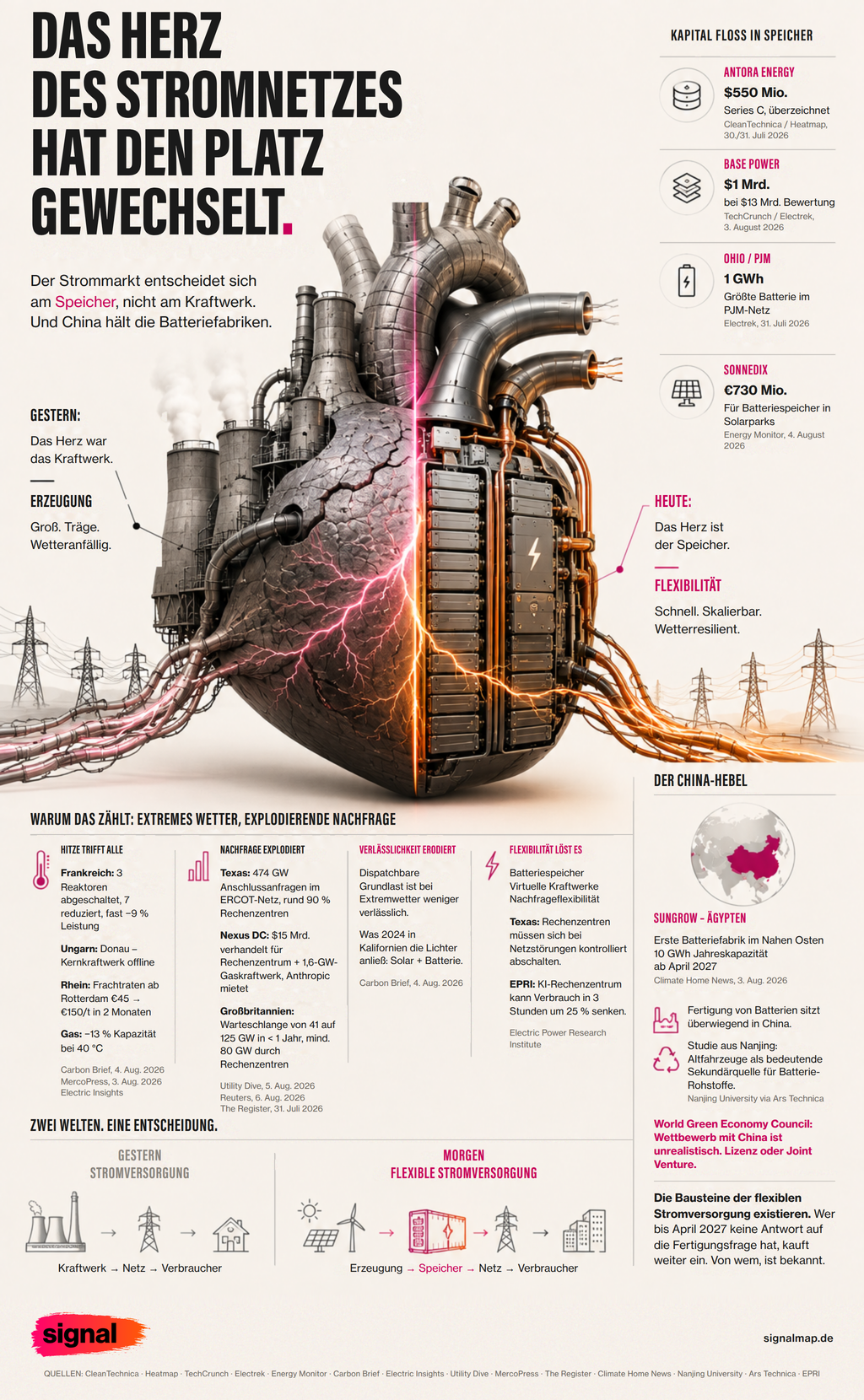
Antora Energy has closed an oversubscribed $550 million Series C (CleanTechnica, Heatmap, 30/31 July 2026). Base Power has raised $1 billion at a post-money valuation of $13 billion, less than a year after its last billion-dollar round (TechCrunch/Electrek, 3 August 2026). In Ohio, the largest battery on the PJM grid is being built, at 1 GWh (Electrek, 31 July 2026). Sonnedix has secured €730 million, explicitly to integrate battery storage into its solar parks (Energy Monitor, 4 August 2026).
The pattern is clear. Whoever puts money into power supply today is putting it into flexibility.
Why it matters
The reason is physics, and in summer 2026 it became uncomfortably visible. During the July heatwave, three of France's 57 reactors had to shut down and seven more reduced output, a total drop of almost 9 per cent (Carbon Brief, 4 August 2026). Low water on the Danube forced Hungary's only nuclear power station to shut down. Freight rates from Rotterdam more than tripled in two months, from around €45 per tonne in June to just under €150 in July (MercoPress, 3 August 2026). Gas power stations lose around 13 per cent of their capacity at 40 degrees (Electric Insights, via Carbon Brief).
The point Carbon Brief draws out cleanly: heat hits every type of generation. Reliable, dispatchable baseload is less reliable in extreme weather than the label promises. What kept the lights on during the California heat in 2024 was the combination of solar and batteries.
Then there is demand. Governor Greg Abbott puts connection requests on the Texan ERCOT grid at around 474 GW, around 90 per cent of them from data centres (Utility Dive, 5 August 2026). Oncor alone, the state's largest transmission operator, reports around 282 GW of requests from data centres as of 30 June 2026. A bank consortium led by Morgan Stanley is negotiating $15 billion for Nexus Data Centers, which is building a data-centre complex in Hubbard, Texas, with its own 1.6 GW gas power station. The tenant is Anthropic; Google guarantees the rent and power payments and receives around 20 per cent of the shares in return. In the UK, the connection queue has risen from 41 to 125 GW in under a year, with data centres accounting for at least 80 GW of it (The Register, 31 July 2026).
The China lever
This is where it gets concrete for German industry. Storage is the answer, and the manufacturing sits mostly in China.
An example that shows the balance of power: in Egypt, the Chinese group Sungrow is building its first battery factory in the Middle East, with 10 GWh of annual capacity from April 2027 (Climate Home News, 3 August 2026). The head of the World Green Economy Council says openly that direct competition with China is unrealistic, and that Egypt should manufacture under Chinese licence or in a joint venture. A study from Nanjing rates retired electric cars in China as a significant secondary source of lithium, nickel, cobalt, manganese and rare earths (Nanjing University, via Ars Technica).
The counter-movement in the US is worth noting. Antora stresses American manufacturing, robust domestic supply chains, welders and electricians in California. Base Power builds in Austin. That's reshoring as a selling point. A 5 GWh storage project in South Dakota was built in twelve months, from start of construction to commissioning. A gas turbine today comes with lead times of years.
What follows from this
The building blocks of flexible power supply exist, and they're being financed on a large scale right now. Battery storage, virtual power plants, demand flexibility. In Texas, large data centres will in future have to shut down in a controlled way during grid disturbances. An EPRI demonstration in Arizona showed that an AI data centre can cut its consumption by 25 per cent over three hours.
The German angle is twofold. First: the manufacturing chain for storage is a strategic bottleneck, and the choice between licence and building your own is due. Egypt has already made it. Second: the Rhine, the Danube, the French nuclear fleet. That was this summer, on the doorstep. Low water on the Rhine could dampen German GDP by 0.1 to 0.2 per cent in the third quarter, estimates Stefan Kooths of the Kiel Institute for the World Economy (28 July 2026).