What happened
The UN Convention on Biological Diversity's global report, as analysed by Carbon Brief, finds countries off track on 22 of 23 targets. 113 of 196 parties (58%) have filed new national biodiversity strategies, two years after the deadline.
Between 2020 and 2023, countries mobilised a cumulative $186.4bn, under $50bn a year against a 2030 goal of $200bn a year. International public finance came to $17.7bn over four years, or $4.4bn a year. The CBD says the $20bn-by-2025 milestone was "likely not achieved".
Where the money stands
The Global Biodiversity Framework Fund received $387.2m in signed commitments from 11 countries and Quebec between August 2023 and 30 June 2026 (GEF data via Carbon Brief).
According to Ribera, the EU is on track to double its international biodiversity finance to €7bn over 2021 to 2027, and its NaturAfrica contribution has reached €1.6bn. The OECD puts international public finance at around $16.1bn a year.
The Cali Fund: two contributions, $6,000 combined (Carbon Brief, October 2026). A Grantham Research Institute (LSE) working paper puts its potential at $3.6bn a year if all 21,690 eligible firms paid, and $929m under realistic uptake. The Cali Watch initiative finds that no government has passed a law requiring companies to pay in.
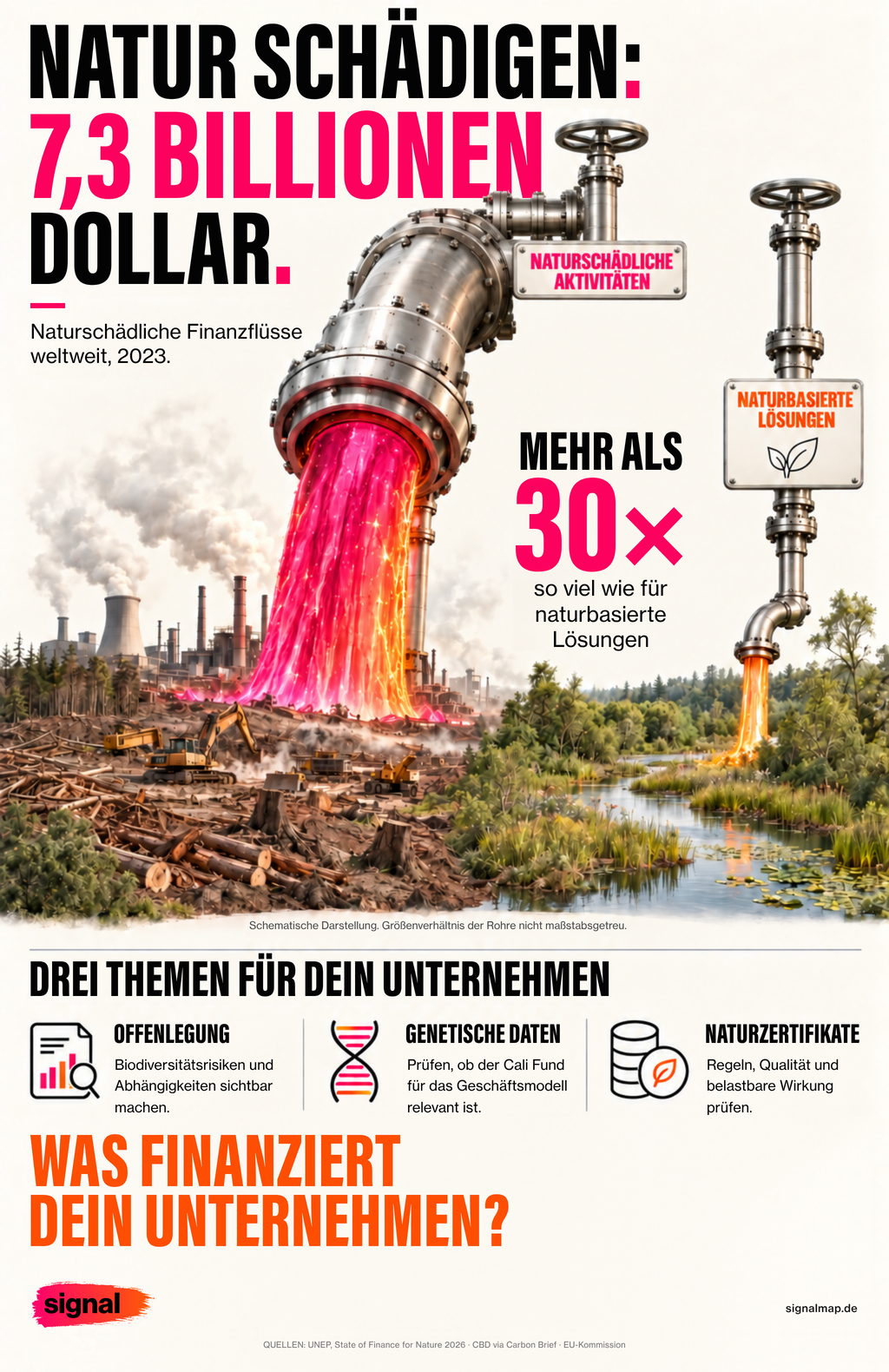
On the other side of the ledger, UNEP puts nature-harmful finance at $7.3tn in 2023. That's more than 30 times what goes into nature-based solutions (State of Finance for Nature 2026).
Where this reaches your business
Disclosure. Target 15 asks governments to get large companies and financial institutions to disclose their biodiversity risks and dependencies. The draft CBD report scores it 0.25 out of 1; the final version leaves the scores out (Carbon Brief). Two-thirds of related national targets show no or insufficient progress. Meanwhile, according to the CBD, thousands of companies already disclose such risks, with more each year. The obstacles the report names include the lack of mandatory reporting frameworks and the exclusion of smaller businesses. So the voluntary lane is busy, and the mandatory one hasn't been built yet.
Genetic data. The Cali Fund targets companies that profit from digital sequence information. EU Executive Vice-President Teresa Ribera is proposing a pilot phase in Yerevan "so that companies are encouraged to contribute". Siva Thambisetty (LSE) is blunter: "I don't believe the shift we need can be generated internally by businesses alone without outside pressure." If your R&D draws on sequence data, this is the agenda item to watch.
Nature credits. The EU is launching a Group of Friends on Nature Credits at COP17. For what strict rules look like, see the UN carbon market. Its Article 6.4 Supervisory Body requires cookstove projects to hand credits to a buffer pool: a flat 20% for human-caused risk, reducible by up to two-thirds. Even then, at least 9% stays in, according to a UN source (Climate Home News). Injy Johnstone of the Max Planck Institute in Munich cautions that policy commitments don't prove the underlying risk has fallen.
Ribera's motto for Yerevan is "from promises to proof". At $6,000, the proof is at least easy to carry.