What happened
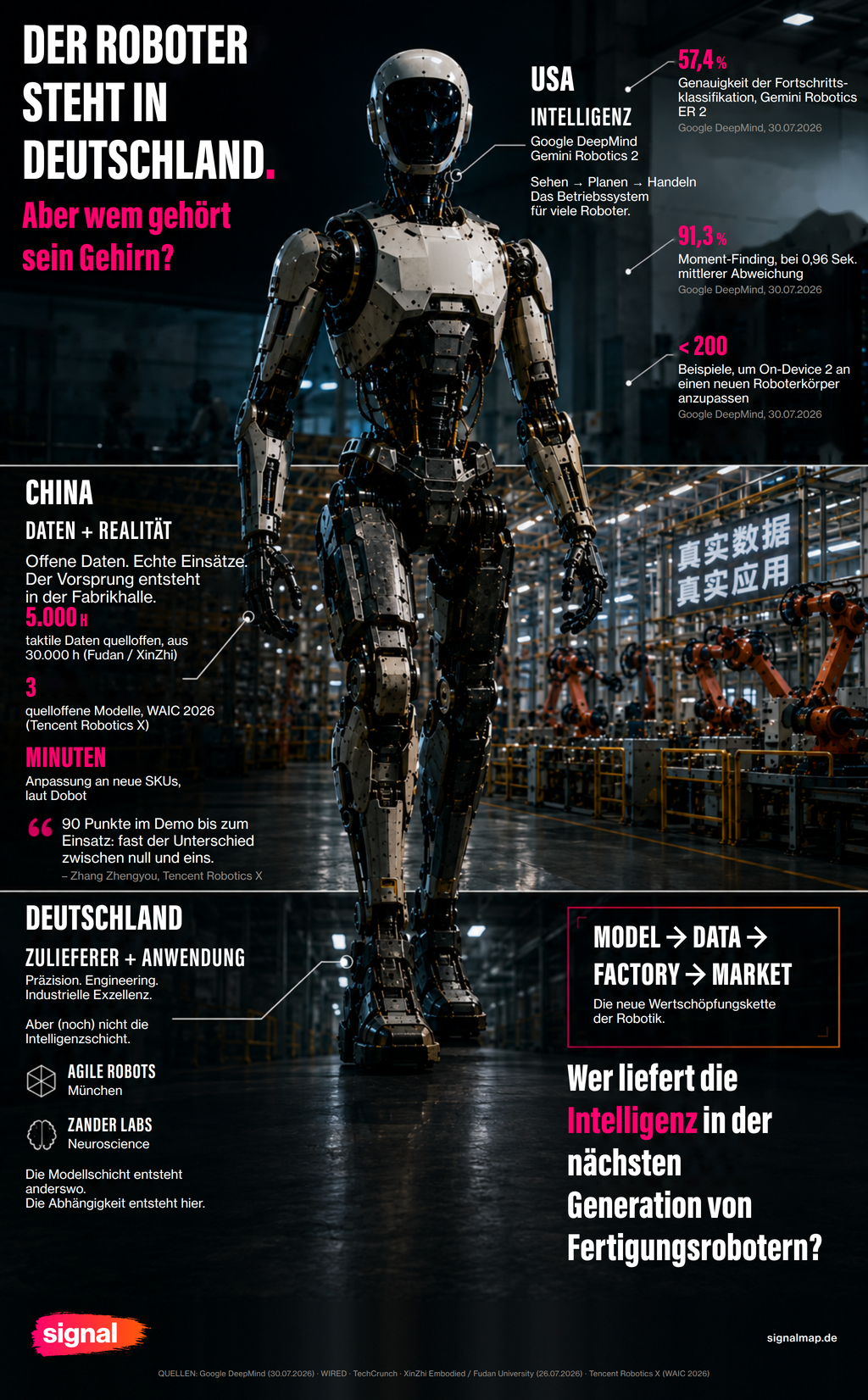
Google DeepMind unveiled Gemini Robotics 2 on 30 July 2026. The leap over the previous version: the model no longer controls just the upper body of a humanoid robot but the whole body, from the feet to the fingertips. Apptronik's Apollo 2 walks to the table, bends down, picks up a watering can and puts it on the right shelf. Five-fingered hands (22 degrees of freedom, SharpaWave) tie knots in string and seal Ziploc bags.
The system consists of three models:
- Gemini Robotics 2 (VLA): translates images and language into motor control, and runs humanoids and bi-arm robots.
- Gemini Robotics ER 2 (VLM): the planning brain. Publicly available now via the Gemini API and Google AI Studio, in private preview on the Gemini Enterprise Agent Platform.
- Gemini Robotics On-Device 2: runs locally, without a network connection, and according to Google DeepMind adapts to new bi-arm robots within a few hours, with fewer than 200 examples.
ER 2's numbers are published. Progress classification: 57.4 per cent accuracy. Moment finding (the exact frame at which an event occurs): 91.3 per cent at a mean deviation of 0.96 seconds, according to Google at a fraction of the compute cost and four times the execution speed of larger models. Also new are collaboration between several robots and a safety benchmark called ASIMOV-Agentic, which tests whether an agent refuses unsafe commands and asks for human intervention when uncertain.
Carolina Parada, head of robotics at Google DeepMind, told WIRED the goal is "physical AGI": a robot that can do everything a human can. Demis Hassabis has held out to WIRED the prospect of an Android for robots, an operating system for many machines.
Why this is more than a Google launch
The real story is in the footnotes of the week.
The bottleneck is the data. In San Leandro, Encord runs a hall where human "pilots" play Jenga, pour coffee and pull Ethernet cables out of servers while cameras and sensors record every movement. Vineeth Velmurugan, formerly of OpenAI's robotics lab, estimates that a breakthrough takes a dataset about five times the size of YouTube's video library. This is exactly where the comparison between robot AI and chatbot AI ends. Scraping text from Stack Overflow cost the language model labs almost nothing. Physical data has to be manufactured. Nobody can just go and collect it. That changes the economics.
China is building exactly this foundation, in the open. On 26 July, XinZhi Embodied and Fudan University released 5,000 hours of tactile interaction data as open source, from a corpus of over 30,000 hours. Licence: CC BY-NC-SA 4.0, so no commercial use. Aimed at the recognised gap in the sense of touch. At WAIC 2026, 17 to 20 July in Shanghai, Tencent Robotics X showed three open-source models. And the decisive line comes from chief scientist Zhang Zhengyou: getting from 90 points in a demo to real deployment, he said, was almost the difference between zero and one. Demonstrating alone was nowhere near enough; it had to be stable and reliable. Tencent's VLA is in production testing on a cosmetics line in Shanghai, at a fixed production cycle. Neither Tencent nor Dobot gives a figure in seconds. Dobot puts the SKU changeover in the range of minutes.
By comparison: with Google's model, Apptronik's Apollo 2 stocks a shelf impressively, though its movement speed still leaves room for improvement. The demo: Mountain View. The factory floor: Shanghai.
The DACH view
Two German names come up, both on the supplier side. Zander Labs, a German neuroscience start-up, supplies Encord with brainwave headsets for an experiment that is still at the trial stage. Munich-based Agile Robots appears in Google's acknowledgements alongside Apptronik and Boston Dynamics. German precision goes into it. The model layer, the operating system, the data factory: all built elsewhere.
Hardly a disaster. But the message is clear. Anyone who wants to use robots in manufacturing will in future buy in an intelligence layer, the way you buy in an operating system today. What matters for Germany's Mittelstand is who supplies the intelligence in the next generation of manufacturing robots, and whether they understand that dependency early enough.
In context
Much of this is real and measured. The ER 2 numbers are published, the model is available, and 5,000 hours of the Fudan data are open source under a non-commercial licence. Little of it is ready to sell to the factory floor. Google itself names speed as an open issue, and TechCrunch took the controls itself: grippers lag far behind human fingers, and "physical AGI" remains a stated goal. There is no product.
Arrival window for productive use of full-body humanoid robots in typical German manufacturing: cannot be reliably derived from these nine sources. What can be derived: competition has shifted from the model to data production, and someone else is doing the testing in the factory right now.