What it's about
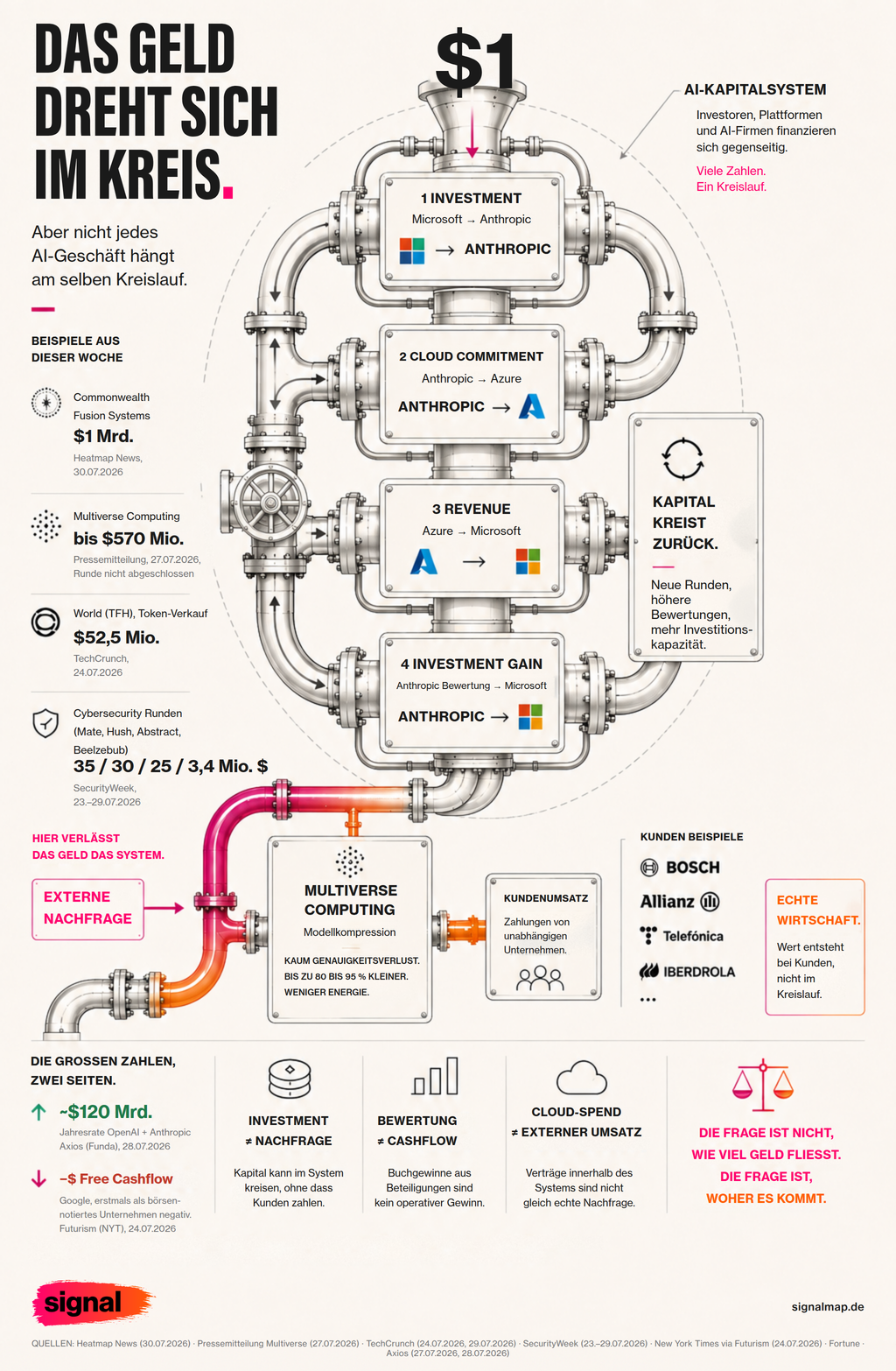
One week, thirteen announcements, one pattern. At the end of July 2026, capital was handed out at a pace that is news in itself. The more interesting story is where the money comes from and where it flows back to.
The hard numbers
The rounds, bone-dry, each with its source:
- Commonwealth Fusion Systems: $1 billion, according to Heatmap News (Katie Brigham, 30 July 2026), with new institutional investors.
- Multiverse Computing (San Sebastián): Series C, target volume of up to $570 million (€500 million), pre-money valuation 1.7 billion, according to a press release of 27 July 2026. Not closed; according to Multiverse, the round may stay open to further strategic investors. Co-leads: Forgepoint Capital International, BNPP SIVF, Bullhound Capital. According to Multiverse, that would bring total funding to $800 million, earlier rounds included. By its own account, revenue has grown more than tenfold since the Series B (June 2025).
- World (Sam Altman, World Foundation; token sale, not equity): $52.5 million through a token sale with a twelve-month lock-up, according to TechCrunch (24 July 2026). Lead buyer: Pantera Capital. In June, TFH went through a round of lay-offs.
- Cybersecurity, round after round: Mate Security 35 million (Canaan Partners, M12, Team8), Hush Security 30 million (Akamai, Battery, YL Ventures), Abstract Security 25 million, Beelzebub 3.4 million. All according to SecurityWeek, 23 to 29 July 2026. What stands out is something else: only one of these rounds sells control over AI agents. According to SecurityWeek, Hush's platform registers, governs and secures AI agents and their infrastructure centrally. Abstract sells a composable security operations platform with no agent angle, Beelzebub sells deception infrastructure against AI-assisted attacks, and Mate Security an agentic SOC that has AI agents do the defending rather than controlling them. The tool creates the problem the next tool solves.
This is the part that matters for DACH. Multiverse is based in the Basque Country, counts Bosch, Allianz, Telefónica and Iberdrola as customers and sells model compression: according to Multiverse, models up to 80 to 95 per cent smaller, with negligible loss of accuracy and lower energy use. For any German industrial company that has to run AI on-premises, or on the workbench without a cloud connection, this is no side issue. A European supplier at the efficiency frontier, based somewhere other than California. That's rare enough to be worth remembering.
The catch
Alongside the rounds ran earnings season, and it tells a second story. Alphabet reported a quarterly profit of $112 billion (New York Times, via Futurism, 24 July 2026). Of the $112.2 billion, 77.1 billion is an after-tax effect of net gains on equity securities, which came to 99.0 billion in the quarter. Fortune attributes the profit mostly to Alphabet's AI holdings, above all Anthropic and SpaceX. At the same time, Google raised its capital expenditure forecast for 2026 to up to 205 billion and, for the first time as a listed company, reported negative free cash flow. The shares fell 6.89 per cent the following day.
Microsoft booked 3.2 billion in profit from its Anthropic stake alone in a single quarter (TechCrunch, 29 July 2026), embedded in an agreement under which Anthropic in turn buys 30 billion worth of Azure services. Money out, money in, same balance sheet.
Axios (27 July 2026) spells it out: according to the Wall Street Journal and Bloomberg, Nvidia is considering a $250 billion guarantee for an OpenAI data centre in southern Ohio. Nothing has been signed. Analyst Billy Leung (Global X) said that this was as much a sign of financing stress in the AI build-out as a demand signal.
What this means for you
Two things are true at once. The revenue is real: according to Axios (28 July 2026, data from Funda), OpenAI and Anthropic together are heading for an annual run rate of around 120 billion. Anthropic alone would be above Starbucks and McDonald's combined. And: a large share of the platform giants' profits comes from booking their investments in one another.
The practical lesson for German decision-makers: separate the companies that make revenue from customers from those that make revenue from their own investors. Multiverse sells to Bosch. Hush sells control over agents that didn't exist eighteen months ago. The first is a business. The second may become one.
Evidence from a single week, widely scattered. We're watching whether the circularity unwinds or sets in. There's no signal here for when the music stops. Anyone who promises one is selling you something.