What it's about
The first week of August 2026 paints a clear picture: in quantum technology, the conversation is moving from physics to the factory. The questions now are: who can make it in volume, who protects themselves in time, and who pays for it?
The facts
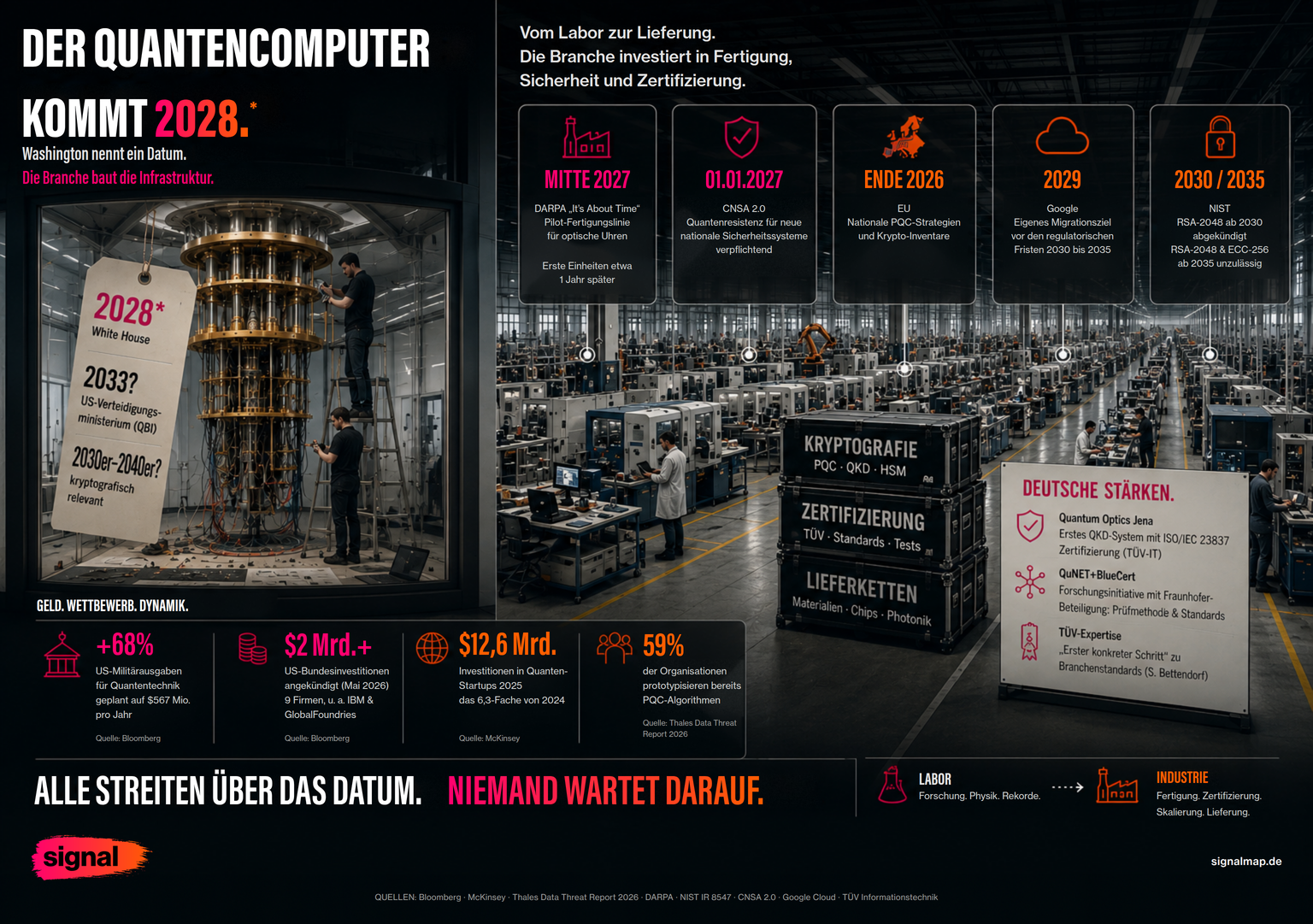
Money and politics, US. According to Bloomberg, US lawmakers want to raise annual military spending on quantum technology by 68 per cent to $567 million. On top of that comes the more than $2 billion in federal investment announced by the Trump administration in May, spread across nine companies including IBM and GlobalFoundries. At the White House Quantum Summit on 7 July, the administration named 2028 as the Department of Energy's target date for a fault-tolerant, scientifically relevant quantum computer. For comparison: the Department of Defense's Quantum Benchmarking Initiative sets 2033. GlobalFoundries CTO Gregg Bartlett, who attended, calls 2028 very ambitious and openly expects the date not to be quite met.
The competition. China has a $10 billion national laboratory for quantum information. According to Bloomberg, Europe and the UK together have pledged almost three times as much public money as the US. Investment in quantum start-ups reached $12.6 billion in 2025, according to McKinsey, 6.3 times the 2024 figure.
The factory turn. DARPA has launched the "It's About Time" programme: a pilot production line for optical clocks, delivered by IonQ through its subsidiary Vector Atomic. The production facility is planned for mid-2027, with first units about a year later. Programme manager Mukund Vengalattore puts the problem plainly: he says the quantum community advances the state of the art exclusively in the lab, and little of it ever reaches practice.
Hardware progress, without the fanfare. Pasqal trapped single rubidium atoms with laser light from a photonic chip: four optical traps, atom lifetime around 27.5 seconds, comparable with existing free-space systems. The aim: shrinking the optical footprint of future processors by up to a factor of 50. A team from Brookhaven's C2QA centre (Princeton) built transmon qubits with T1 lifetimes of up to 1.68 milliseconds. According to Princeton, that is roughly three times the best value previously measured in a lab, and almost fifteen times the industry standard for large processors. The difference is the substrate: high-resistivity silicon instead of sapphire, with tantalum as the base layer in both cases. NIST transmitted entangled photons over 62 kilometres of existing overground fibre, 1,500 photons per second, maintaining entanglement for 92.8 per cent of a 24-hour test, stabilised with technology from Qunnect.
Post-quantum cryptography, the concrete side. Thales launched the Luna 8 hardware security module. According to the Thales Data Threat Report 2026, 59 per cent of organisations are already prototyping PQC algorithms. Quantum Optics Jena's ELVIS system passed six independent security tests under ISO/IEC 23837 at TÜV Informationstechnik, examined for side-channel attacks on the hardware.
The DACH angle
Two German names come up in the detail, both on the manufacturing and security side, well away from the headline billions. Quantum Optics Jena says it is the first company to put a QKD system through this level of testing. The test methodology was developed under QuNET+BlueCert, a German research initiative involving Fraunhofer. So German substance sits exactly where the industry is heading: certification, hardware hardening, standards.
For you, the other German figure matters most. TÜV expert Sven Bettendorf calls the ELVIS test a first concrete step towards the certification standards the industry will need. Since 19 August 2026 there has been a first one: NIST's CMVP programme validated Crypto4A's QASM module to FIPS 140-3 Level 3 with ML-KEM and ML-DSA inside the module boundary (certificate 5497). The certification infrastructure is lagging behind the technology.
The timeline
On post-quantum migration, the situation is unusually clear. NIST's draft IR 8547 provides for RSA-2048 (112-bit security level) to be deprecated after 2030 and disallowed after 2035, and ECC-256 (128-bit) to be disallowed after 2035. CNSA 2.0 requires quantum resistance for new national security systems from 1 January 2027. The EU wants national PQC strategies and crypto inventories by the end of 2026. Google has set 2029 as its own migration target, by its own account well ahead of the regulatory deadlines, which Google Cloud places between 2030 and 2035 with CNSA 2.0 and NIST IR 8547, and cites faster-than-expected progress in hardware and error correction. Cloudflare followed suit: more than 65 per cent of human traffic there already runs post-quantum encrypted.
That's the signal. Those sitting closest to the hardware set the tightest deadlines. Experts put the arrival of a cryptographically relevant quantum computer anywhere between the early 2030s and the mid-2040s. But not a single serious organisation has published a wait-and-see position. Disagreeing about timing isn't the same as disagreeing about direction.
In context
The share prices tell the other half of the story. D-Wave, Infleqtion and Rigetti have fallen markedly since the start of the year, while AI and semiconductor stocks gained. CSIS adviser Philip Singerman told Bloomberg that investors remain sceptical about the near-term commercial prospects. IonQ is the exception: its $1.8 billion acquisition of the foundry SkyWater completed, annual guidance raised, share price recovered.
For you, that means two things. First: the product-ready side of quantum today is cryptography, not computing. Crypto inventory and crypto agility are infrastructure work that starts now. Second: the interesting moves in the industry are in manufacturing, certification and supply chains. Precisely the fields where German industry has traditionally known a thing or two. You don't have to chase every qubit record. You do have to know which deadline hits your sector first.