What happened
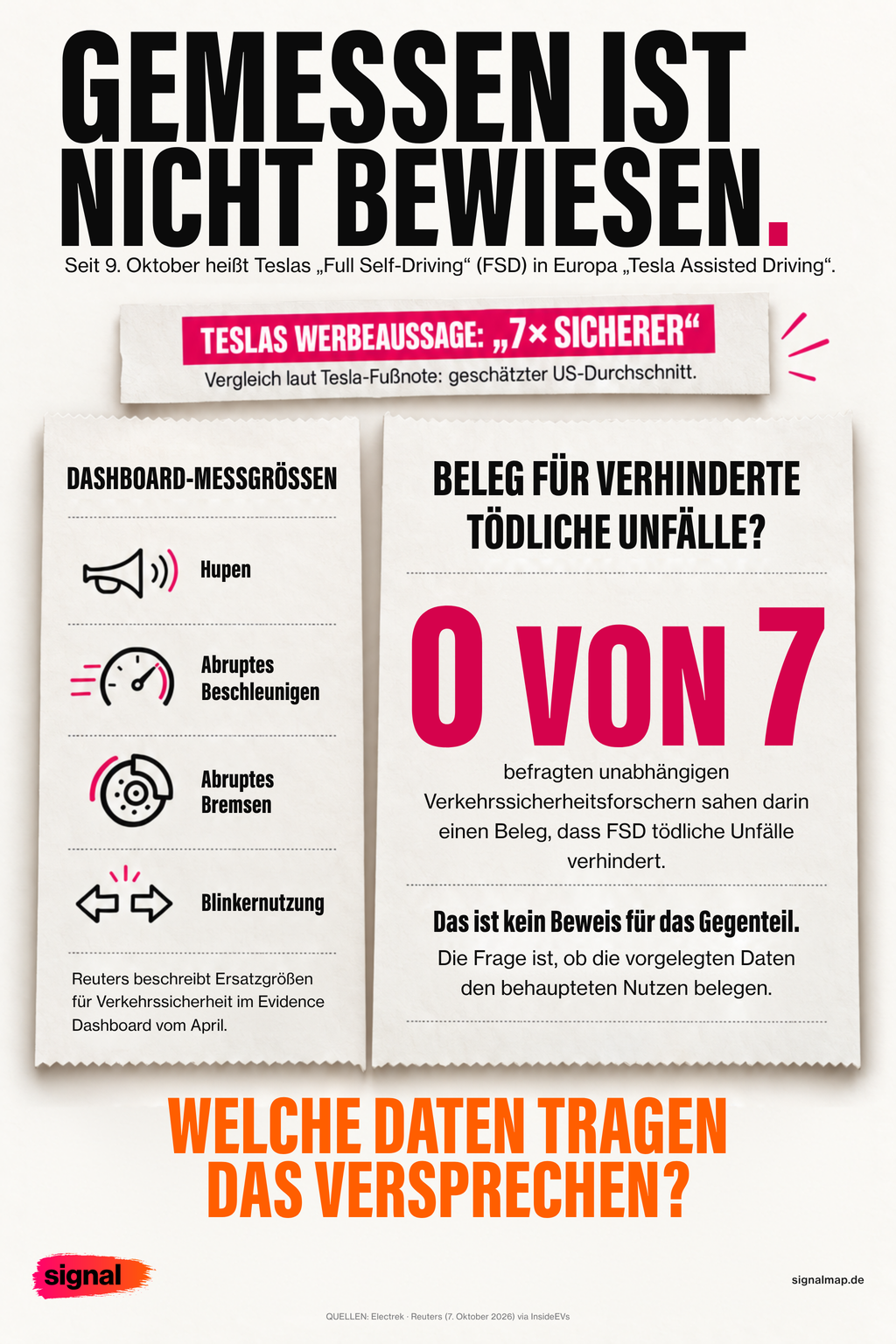
Since 9 October, Tesla's European websites have called its driver-assistance package "Tesla Assisted Driving". Electrek reports that the old German address for Full Self-Driving (FSD) now redirects to the new page. Reuters found the new name on the Spanish and Dutch pages too.
Germany's Federal Ministry of Transport (BMV) had called the old name misleading in a statement on 6 October. The system doesn't take over the full driving task, and the driver stays fully responsible. According to the ministry, Tesla offered the rename itself, in talks with Transport Minister Steffen Bilger in September.
Then there's speed. Germany will back a cap of 10% above the limit in the EU process. Reuters reported that the version approved in the Netherlands allows up to 50% over the detected limit (via Electrek). Tesla has to change the software to comply. In return, Bilger wants EU-wide approval "as quickly as possible". InsideEVs points out that the statement backs the EU process and stops short of approving the current version.
Where approval stands
Eight EU states allow the system: the Netherlands, Lithuania, Estonia, Denmark, Belgium, Slovenia, Czechia and Croatia. Germany isn't on Tesla's list yet. According to Electrek, the EU vote comes in December at the earliest. It needs 15 of 27 member states representing 65% of the EU population. France and Sweden have raised concerns about speeding.
The package costs €99 a month in Europe and $99 in the US. FSD passed 1.48 million subscribers in July (InsideEVs).
What hasn't changed
Electrek calls it a find-and-replace job. The German page still says the car will drive you "almost anywhere" under supervision. It still claims the system is "7x safer" than human drivers, a figure Tesla's own footnote benchmarks against the estimated US average. And it still signs off with "Die Zukunft ist autonom".
The evidence question
A Reuters investigation published on 7 October (via InsideEVs) examined Tesla's April "Evidence Dashboard". It leaned on behavioural surrogates such as horn use, sudden acceleration and braking, and turn-signal use. None of the seven independent traffic-safety researchers Reuters consulted thought it showed that FSD prevents fatal crashes.
Internal emails show Tesla pressing the Dutch regulator RDW to narrow its review. One RDW staffer offered to "adjust or reduce" the scrutiny. The RDW says such exchanges are routine and don't compromise its independence. Officials in Sweden and Norway received dozens of emails from Tesla fans, some telling them they'd be responsible for deaths if approval was delayed.
In the US, NHTSA opened a preliminary inquiry on 9 October into about 1,000 robotaxis, model-year 2026 Model Y and Cybercab, over speeding in active school zones. It recorded four reported incidents; no crashes or injuries are among them (Quartz, citing Bloomberg).
What this means for you
Europe's regulators are looking past the name now. Berlin has put two conditions in writing: a name that matches the function, and no more than 10% over the limit. The researchers Reuters showed the dashboard to saw no proof in it. The EU votes in December at the earliest.
If you market driver assistance in the EU, the bar is now public: a name that matches the function, a speed limit written into the software, and evidence that safety researchers accept as evidence.
So the name has caught up with the product. The website copy is still on its way.