The entry level
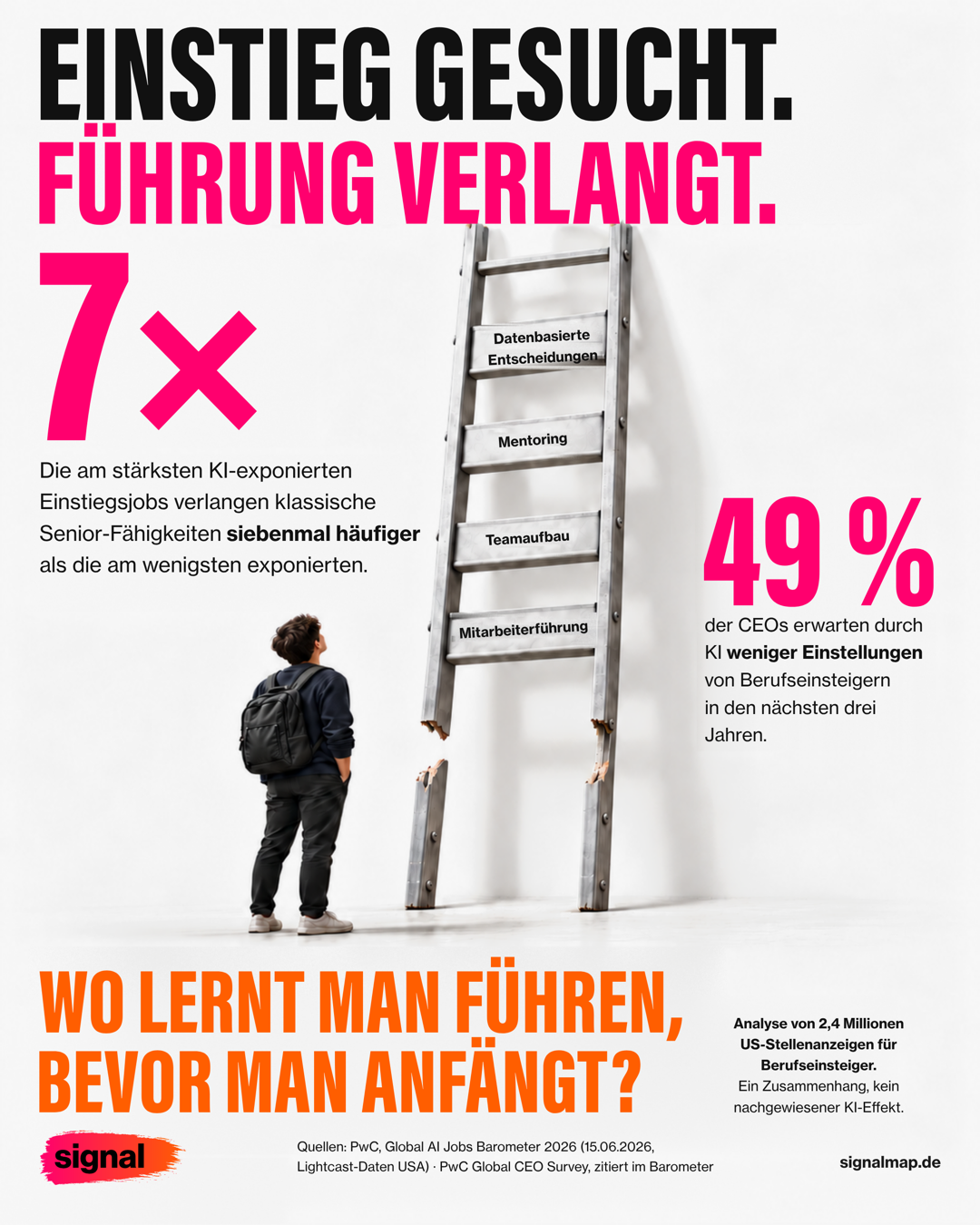
The figures come from PwC's Global AI Jobs Barometer 2026 (15 June 2026). The skills in demand include people management, team building, mentoring and data-driven decision making. Entry-level roles with such new requirements grew 35% between 2019 and 2025. The other AI-exposed entry-level roles shrank. PwC says this doesn't show that AI caused it. The CEO figure comes from PwC's Global CEO Survey.
The managers
Nielsen surveyed 1,701 directors and senior managers at companies with 500+ staff for Monday.com, across seven countries, 200 of them in Germany (April 2026). 53% find it harder to judge their people's original work since adopting AI. 39% use AI to draft performance reviews (TechCrunch, 21 October 2026). 47% spend more time reviewing and guiding. 58% expect to oversee more AI agents than people within twelve months.
Charter surveyed 5,002 US office workers who use AI in August. 32.8% of executives and 34.8% of managers trust AI more than their own judgement. Among individual contributors it's 16.3%. The measure is self-reported trust.
The savings
Three-quarters of board members expect AI to raise productivity and cut costs. Three per cent of organisations achieve the savings they wanted through productivity alone (Gartner, HR Symposium, 27 October 2026). 38% of companies are over budget on AI. 85% plan to spend more next year all the same. Time does get freed up; it just rarely ends up in new work. A Gartner survey of 1,865 employees (Q2 2026) found 21% of the time AI frees up goes into more innovative tasks. Gartner analyst CV Viverito says capacity is already being created. Making it usable is the hard part.
The learning
The only controlled trial in this set appeared in Nature Human Behaviour (Wiles, Krayer et al., 26 October 2026). 487 BCG consultants each took on two of three short data science tasks outside their field, some of them with ChatGPT and training. With ChatGPT they beat the control group on all three tasks and fell short of real data scientists. On five technical questions afterwards, without ChatGPT, they were no better. The authors call AI an "exoskeleton": the capability lasts as long as the tool is switched on. Six co-authors are or were BCG employees, and one works at OpenAI.
The distribution
Pew Research Center analysed 480 US occupations using Current Population Survey data, comparing 2017–19 with 2023–26 (22 October 2026). Pew scores AI exposure on its own scale of 0 to 3.5. For each one-point rise in exposure, the number of men employed grew 6.3% and the number of women 0.2%. Among workers with a high school diploma or less, men's employment rose 8.8% per point and women's fell 9.5%. Women without four-year degrees often work as secretaries, receptionists or in customer service. Pew stresses the link isn't necessarily direct.
What to take from it
Most of the figures are American; one survey includes Germany. The questions apply here just the same. Who on your team checks AI output, and is that time in anyone's plan? Could your people still do the task without the tool? And where do your new starters learn to lead, when the job ad asks for it on day one?
Sources: Gartner (via The Register, Communications Today, 27 Oct 2026) · monday.com/Nielsen (Business Wire and TechCrunch, 21 Oct 2026) · Charter (via Axios, 21 Oct 2026) · Nature Human Behaviour (26 Oct 2026) · PwC, Global AI Jobs Barometer 2026 · Pew Research Center (22 Oct 2026)